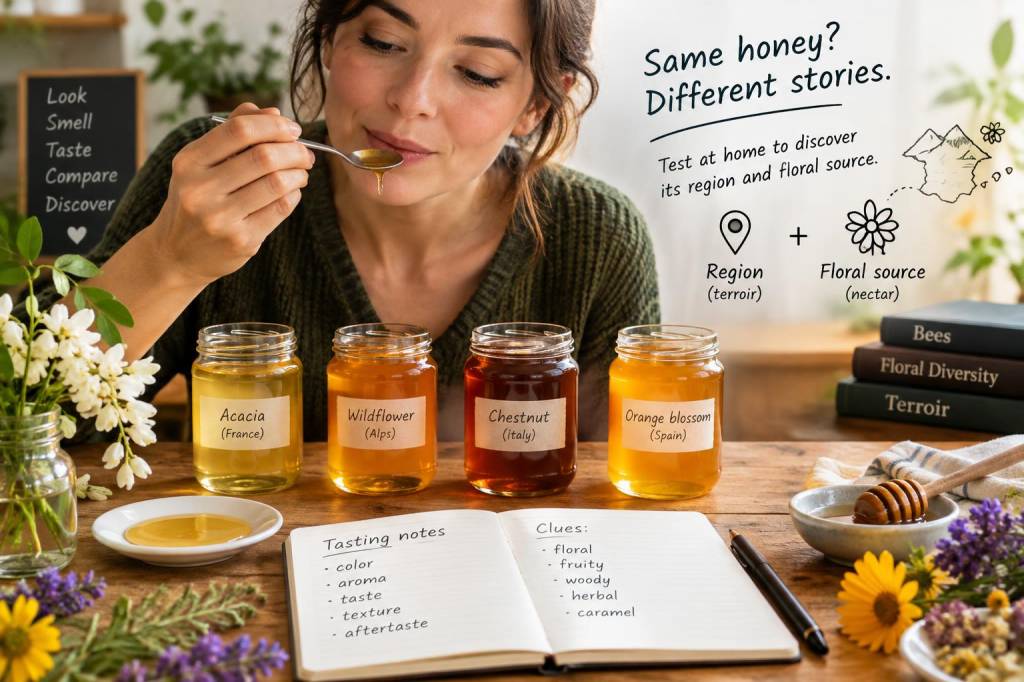
I’ve always been fascinated by how a single spoonful of honey can tell a story: the landscape bees visited, the season it was collected, even the traditions of a region. While laboratory pollen analysis (melissopalynology) and chemical testing give the most reliable answers, you can learn surprising things at home with a few simple observations and low-tech tests. Below I share hands-on methods I use as a curious taster to get clues about honey’s region and floral source, along with what those clues really mean.
Look, smell, taste: the sensory starting point
The easiest and most rewarding way to start is simply with your senses. Pour a teaspoon onto a white plate and observe:
These sensory cues aren’t definitive, but they’re a fun and informative first pass.
Heat test — viscosity, aroma change, and troubleshooting
Warming honey slightly (not boiling) can amplify aromatics and change viscosity, which gives more clues. I use a small glass jar placed in warm water (about 40–45°C) for a minute.
Be careful: overheating honey above about 40–50°C can alter flavor and destroy valuable enzymes.
Crystallization test — clues about sugar profile and floral source
Crystallization behavior tells you a lot. Hold a spoon of honey at room temperature and note if and how fast crystals form.
If you want to accelerate a crystallization test, put a jar in the fridge for a day and see what happens. Remember this is an indicator, not proof.
Water test — solubility and moisture hints
Honey absorbs moisture quickly; its moisture content influences fermentation risk and can vary with region and season. You can do a simple home water test:
Hot-water sediment and pollen spotting
This is my favourite low-tech move to catch visible pollen or sediments that hint at region or plant families. You’ll need a clear glass, hot water, and a fine mesh or coffee filter.
I’m honest: without lab microscopy you won’t get species-level certainty, but you might spot signs that point toward meadow mixes, tree pollens, or heather-type plants.
Fluorescence and a quick UV check
Under a small UV torch (blacklight), some honeys fluoresce differently depending on floral source and storage. Try dimming the lights and shining a handheld UV lamp on a thin layer of honey.
Context matters — labels, jar origin, and seasonality
Don’t ignore the metadata. Where and when honey was bottled, any beekeeper notes, and certifications (like Protected Designation of Origin or local organic marks) are often the strongest clues. I always keep a small notebook or a photo of the label when I try new jars.
| Clue | What it suggests |
|---|---|
| Dark color, strong toasted aroma | Late-season nectar (buckwheat, chestnut) or honey from certain regions like Eastern Europe |
| Pale, almost transparent | Acacia, citrus, or light spring wildflowers |
| Rapid crystallization, fine powdery crystals | High-glucose sources like rapeseed or sunflower |
| Visible pollen/residue after filtration | Minimally processed, likely local or small-batch |
What these home tests can’t reliably do
It’s important to be realistic. Home tests can nudge you toward likely floral families or hint at rural versus mass-produced sources, but they can’t confirm botanical species or exact region with certainty. Adulteration — sugar syrups, inverted sugar, or blended imported honeys — can mimic many properties of pure honey. For legal or commercial verification you need lab methods: pollen analysis, carbon isotope ratio testing (to detect cane or corn sugar), and chromatography for specific markers like methylglyoxal in manuka.
When I’m especially curious, I’ll reach out to a local university lab or a reputable private lab like Intertek or Eurofins. For everyday curiosity and food joy, though, these home methods keep me engaged and often reveal delightful surprises: a jar labelled simply “wildflower” that smells unmistakably of orange blossom, or a shop-bought honey that crystalizes like rapeseed despite its label.
If you’d like, I can walk you through a step-by-step video-friendly checklist you can save on your phone when testing honeys at markets or in the kitchen.