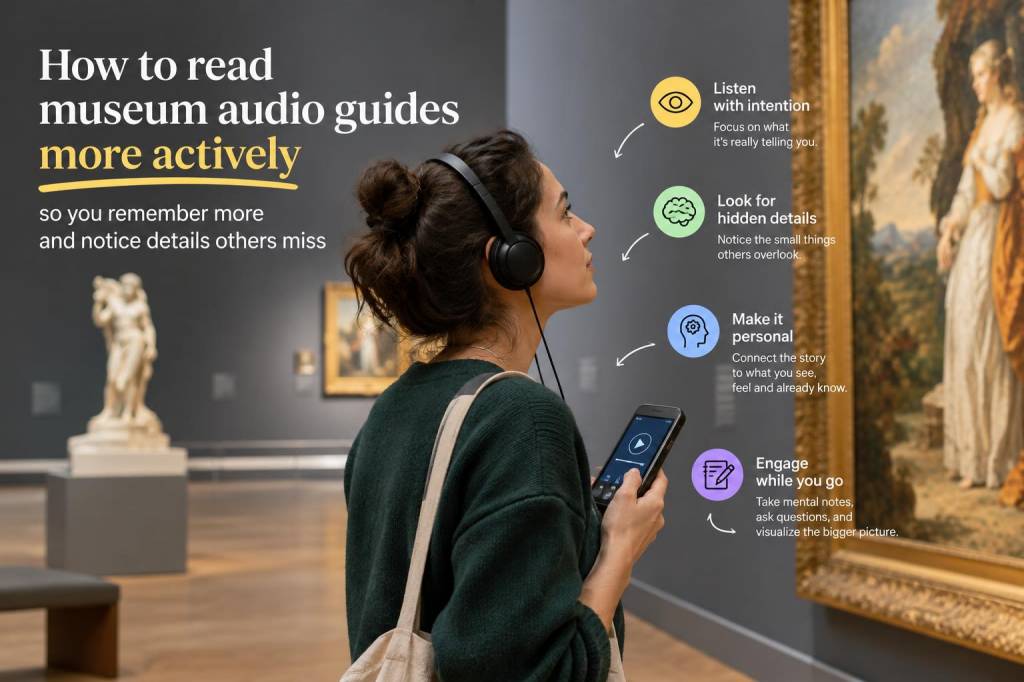
I used to treat museum audio guides as pleasant background noise: press play, glance at a label, drift to the next object, repeat. I heard a lot, but I retained very little. Over time, I noticed that when I changed a few small habits, museum visits became richer and much more memorable. I started spotting brushstrokes, recurring symbols, tiny repair marks, and design choices I would once have walked past. An audio guide stopped feeling like a script and started feeling like a conversation with the collection.
What changed was not my ability to “study” art or history. It was my approach. I began listening with intention, pausing at the right moments, and using the guide as a tool rather than a soundtrack. That shift made me remember more after I left, and it also helped me notice details other visitors seemed to miss. If you have ever left a museum with the feeling that you enjoyed yourself but could not quite explain what you saw, this approach may help.
Start before pressing play
When I arrive at a gallery, I resist the urge to rush straight into listening. I take a slow look at the object first, even if only for twenty or thirty seconds. I ask myself what stands out immediately: color, size, material, expression, damage, framing, placement, or contrast. This short pause gives my brain something to attach the audio to. If I hear facts before I have formed my own impression, everything tends to blur together. If I form an initial impression first, every detail in the recording has something to “stick” to.
I also read the wall label before pressing play, but only briefly. I want just enough context to orient myself: date, maker, origin, and perhaps one sentence about why the piece matters. That tiny amount of preparation makes the audio guide feel like a deepening layer rather than a first encounter. I learn more because I already have a question in my mind, even if it is a simple one such as: Why is this object placed here?
Listen in short bursts, not as one long stream
One of my biggest mistakes was trying to absorb an entire audio track while continuing to scan the room. Museums are full of competing signals: footsteps, conversations, reflections in glass, and the visual pull of nearby works. A long uninterrupted listen often becomes passive listening. I get the words, but not the meaning.
Now I prefer shorter bursts. I listen to a section, pause, look again, and then listen once more if needed. That rhythm gives me time to process what I have heard. It is especially useful when a guide mentions a specific detail such as a symbolic gesture, an unusual pigment, or a restoration choice. I can return my eyes to the object and confirm what I just learned. That act of matching sound with sight is where memory starts to strengthen.
If the museum app allows chapter markers, I use them generously. If it does not, I simply pause manually. I have found that a pause is not a disruption; it is part of the experience.
Turn facts into questions
Audio guides often present information in a polished, compact form. That is useful, but I remember more when I turn each fact into a question. If a guide tells me that a portrait was painted for a wedding, I ask myself what kind of message the sitter wanted to send. If I hear that a vessel was made for export, I wonder what traveled with it and what changed as it moved across borders. If the recording mentions a damaged corner that was left visible during restoration, I look for the exact boundary between original surface and repair.
This habit changes me from a receiver into a participant. Instead of letting the audio wash over me, I start building a small mental puzzle. Questions create attention, and attention improves memory. I do not need to answer everything on the spot. In fact, the curiosity itself is often what makes the visit stick.
Look for three layers at once
When I want to notice more, I try to observe each object through three layers: form, context, and effect. Form is what I can literally see: shape, color, texture, scale, composition. Context is what the guide tells me about origin, purpose, audience, or history. Effect is my own reaction: calm, discomfort, admiration, confusion, delight, or even boredom. All three matter.
This simple framework keeps me from listening too narrowly. I am not only collecting information; I am also checking how that information changes what I see and feel. A carved figure may seem decorative at first, but once I learn it was meant to signal authority, its posture may suddenly look more severe. A landscape may seem peaceful, but once I hear about industrial change or political tension, the same scene feels charged. That shift is memorable because it is emotional as well as intellectual.
| Listening habit | What it improves | What I do in practice |
|---|---|---|
| Short pause before audio | Initial attention | Look first, then listen |
| Brief note taking | Recall after visit | Write one phrase or one question |
| Repeated listening | Detail recognition | Replay one segment near an object |
| Question making | Deeper engagement | Turn each fact into curiosity |
Write down only one or two things
I used to try to capture too much. I would scribble a lot, then read almost none of it later. Now I keep notes very small. I write one surprising fact, one visual detail, or one question I want to remember. That is enough. A single sentence can do more work than a page of hurried notes.
For example, if an audio guide explains that a pattern on a ceramic piece refers to trade routes, I may write: Pattern links object to movement, not just decoration. That sentence is compact, but it preserves the idea in a way my memory can revisit later. On a train home, or days later while talking to someone, I can often reconstruct much more from that one line.
Sometimes I also note what I felt before and after hearing the guide. If an object seemed plain at first but became unexpectedly moving after the explanation, I write that contrast down. Memory often lives in change, not only in information.
Use your body as part of listening
I notice more when I stop standing like a commuter and start moving like an observer. I lean slightly closer, step back, crouch, and view from different angles when possible. A guide may mention a detail that only becomes visible from below, from the side, or from a distance. If I stay fixed in one position, I risk missing what the object is designed to reveal.
Body movement also helps attention. A small physical change can reset my focus. I may shift my weight, remove one earbud for a second, or walk a half step to the left. These tiny adjustments keep the visit from becoming mechanically passive. I find that I remember more when my body and ears are working together rather than treating listening as a separate, disconnected task.
Repeat the name out loud in my head
One surprisingly effective habit is to silently repeat the name of the artist, object type, or historical period after hearing it. Not every word, just the key one. Names can act like hooks. If I hear “limestone relief,” “portrait miniature,” or “bronze casting,” repeating the phrase helps me anchor the object in memory. It sounds simple, but it keeps important terms from sliding away as soon as I move on.
I also try to connect a name with one image or one idea. A date may stick because it belongs to a political event I already know. A place name may stick because I have a personal association with it. The more links I create, the less likely the memory is to disappear into a general blur of “things I saw at a museum.”
Notice what is not said
Some of the richest moments happen when the audio guide leaves something open. Maybe it describes a missing section, a disputed attribution, or an uncertain function. Rather than treating uncertainty as a gap, I treat it as part of the story. What does the museum know for sure, and what remains debated? Why might the guide choose this wording instead of a firmer claim?
That kind of listening makes the museum feel alive. Objects are not frozen facts; they are evidence, interpretation, and sometimes mystery. I remember those moments because they ask me to think, not merely to receive. I often leave with one unresolved question that stays with me longer than a dozen tidy facts.
A small active-listening routine I return to
- Look first, before any audio begins
- Read only a brief label for context
- Listen in a short section, then pause
- Match one spoken detail to one visible detail
- Write one sentence, not a long paragraph
- Ask one question before moving on
- Revisit one favorite object near the end of the visit
That last step matters more than I expected. Returning to one object after several other galleries have passed often reveals how much my perception has changed. The guide’s details feel more integrated, and my eye has become sharper. What once seemed decorative now appears structural, symbolic, or historically loaded. That second look is where the visit often becomes unforgettable.
If a museum offers transcripts, I sometimes glance at them after leaving, not during. Reading a few lines later helps me reinforce what I heard without distracting me in the moment. I also find that a transcript lets me compare what I remember with what was actually said, which strengthens recall for future visits.