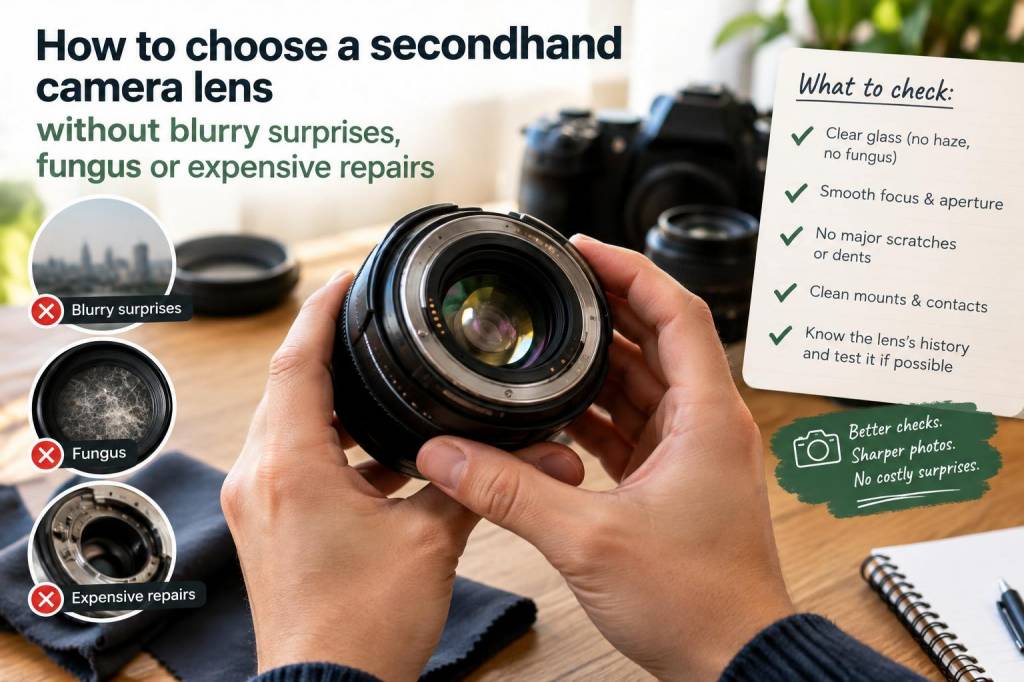
I have bought used camera lenses for years, and I still treat every purchase like a small investigation. A secondhand lens can be a brilliant bargain: a classic portrait lens, a fast zoom for travel, or a premium optic that would have been out of reach at full retail price. It can also be a costly mistake if I rush, skip inspection, or trust a seller’s description too much. What I look for is not only sharpness, but also signs of moisture damage, internal haze, worn mechanics, and repair history that may hide future trouble.
My approach is simple: I try to learn as much as I can before money changes hands, and I inspect the lens in person whenever possible. If I cannot see it in person, I ask for very specific photos, sample images, and direct answers. A used lens is not just a piece of glass; it is a moving mechanical object with coatings, seals, aperture blades, focus groups, and often a history that leaves clues. Once I learned to read those clues, I stopped buying on hope and started buying on evidence.
What I check before I even consider a lens
I begin with compatibility, because a cheap lens is never cheap if it does not fit my camera or cannot do what I need. I confirm mount type, sensor coverage, autofocus support, and whether any special adapters will be required. I also look at my own use case. A lens for indoor portraits, for example, has different priorities from a lens I want to carry on hikes or use for video.
Then I compare market value. If a price is far below normal, I do not assume I found a bargain. I assume there is a reason. That reason might be cosmetic wear, but it might also be fungus, decentering, stuck aperture blades, or a seller trying to move a lens with intermittent autofocus. I would rather pay a fair price for a clean lens than gamble on a suspiciously cheap one that needs a repair costing more than the lens itself.
I also read the seller’s wording carefully. Phrases like “untested”, “as is”, “for parts or repair”, or “minor haze” can mean very different things depending on the person, but I treat them as warning flags. If a seller avoids direct answers, I usually walk away.
My physical inspection routine
When I hold a used lens, I start with the outside. Cosmetic wear is normal, especially on older gear, but heavy dents, cracked filter threads, loose switches, or missing rubber grips can hint at rough handling. I check whether the mount sits flush and whether the lens wobbles on the camera body. A little paint wear is fine; structural damage is not.
Next I look through the glass with a bright light. I do not need a studio setup for this. A phone flashlight or window light is often enough. I tilt the lens slowly and scan both front and rear elements for scratches, cleaning marks, chips, haze, and dust. Tiny dust specks are common and usually harmless. Deep scratches, however, can reduce contrast, increase flare, and reveal careless ownership. A few faint cleaning marks may not matter much, but anything obvious deserves caution.
Fungus is one of my biggest concerns. It often looks like delicate branching threads, spiderweb patterns, or tiny filaments spreading across internal surfaces. Sometimes it begins as a small spot; sometimes it has already etched into coatings. Even if fungus appears mild, I ask myself whether I want to risk contamination spreading to other lenses in my bag. I usually do not. Fungus is not just a cosmetic issue; it can become a long-term optical problem and may require disassembly, cleaning, and possible replacement parts.
Haze can be harder to spot. It may appear as a soft veil inside the lens, especially when light shines through at an angle. Haze lowers contrast and can make images look tired even if focus is accurate. I have seen lenses that looked clean at first glance but lost punch in actual photos because of internal haze.
What movement and mechanics tell me
I test the focus ring first. It should move smoothly, with even resistance and no grinding sounds. Manual focus should not feel sticky or jumpy unless the lens design itself is unusual. I rotate the zoom ring, if present, and listen for roughness or looseness. A lens that “breathes” in a loose, floppy way may have worn internal guides.
Autofocus testing matters just as much. I mount the lens and check whether focus locks quickly and accurately across several distances. If possible, I test in good light and low light. Slow hunting is not always a deal breaker, but repeated failure to lock can point to motor wear, electronic problems, or calibration issues. I also listen for unusual noises: buzzing, clicking, squealing, or a sound that feels more strained than normal.
Aperture blades deserve attention too. I set the smallest and widest openings and watch whether the blades move cleanly. Oil on the blades is a serious red flag, because it can cause inconsistent exposure and may indicate internal wear. Stiff or uneven blade movement can also signal expensive service ahead.
Simple image tests I never skip
Even a lens that feels fine physically can produce disappointing images, so I always make sample photos. I do not need a perfect testing lab; I just need consistency. I photograph a flat subject like a brick wall, a bookshelf, or a high-contrast scene with detail across the frame. Then I inspect the corners, center, and edges at full resolution.
I am looking for sharpness balance, not just central sharpness. A lens with decentering may look sharp on one side and soft on the other. That can happen after a drop or rough repair. I also look for unusual color fringing, strong flare, ghosting, or odd softness that persists even after I stop down. Some lenses are naturally characterful, but there is a difference between charming rendering and optical damage.
Focus consistency matters too. I take several shots at the same subject and distance. If one image is sharp and the next is not, I want to know whether the issue comes from my camera settings, the lens, or a mechanical fault. I also check whether infinity focus reaches properly, especially on older or adapted lenses. If a lens cannot focus where it should, the issue may be more than simple wear.
Questions I ask every seller
I have learned that good questions save money. A serious seller usually answers clearly and directly. I like to ask:
- Has the lens ever been dropped, repaired, or opened?
- Are there any scratches, haze, fungus, or oil on the blades?
- Does autofocus work reliably across the full range?
- Are both caps, the hood, and any original packaging included?
- Was the lens stored in a dry place?
- Can you send close-up photos through a bright light?
The answers matter, but so does the tone. If the seller seems vague, defensive, or impatient, I take that seriously. Honest sellers usually know their gear well enough to describe it plainly. A seller who says “I never used it much” but cannot provide basic details makes me cautious.
What I consider a fair risk and what I avoid
I am willing to accept a little dust, normal cosmetic wear, and even minor paint rub on older lenses. I am less comfortable with fungus, oily blades, strong haze, sharp knocks, missing screws, or evidence that someone tried to open the lens without proper tools. I also avoid lenses with uncertain electronic behavior, because repair costs can climb quickly when circuits or motors fail.
Here is how I usually weigh common issues:
| Issue | My reaction | Why it matters |
|---|---|---|
| Light dust | Usually acceptable | Common in used optics and often has little effect |
| Minor exterior wear | Usually acceptable | Cosmetic only if mechanics and optics remain clean |
| Small cleaning marks | Depends on severity | May reduce contrast if heavy or numerous |
| Fungus | Usually avoid | Can spread, etch coatings, and require full service |
| Haze | Usually avoid unless very cheap | Can soften contrast and indicate deeper issues |
| Sticky aperture blades | High caution | May need costly mechanical repair |
| Decentering | Usually avoid | Can ruin edge sharpness and be hard to fix |
| Drop damage | Usually avoid | Hidden internal damage is common |
Where I feel safest buying
I feel most comfortable when a marketplace offers buyer protection, clear return rules, and a seller with a strong history. Local camera stores with used departments can be excellent because they often inspect gear before listing it. Dedicated photography marketplaces can also be good if they provide detailed photos and transparent descriptions. Peer-to-peer sales can be fine too, but only when I can inspect the lens carefully and I am prepared to walk away.
If I buy online, I prefer listings with multiple close-up images taken in natural light, plus sample photographs. I also like it when the seller is willing to answer questions without pressure. A fair return window can turn a nervous purchase into a manageable one, because some problems only show up once I mount the lens on my own camera and test it in real shooting conditions.
What has saved me from expensive mistakes
The biggest lesson I have learned is to slow down. A secondhand lens can look beautiful in photos and still hide problems that only appear under a flashlight, during autofocus testing, or in the corners of a test image. I have avoided bad purchases by trusting a slightly soft corner pattern, a strange smell from inside the barrel, a sticky aperture, or a seller’s unwillingness to discuss repair history.
I also trust my own instincts. If a lens feels wrong in the hand, sounds wrong when it moves, or comes from a listing that raises too many questions, I do not force the deal. There will always be another lens. What I want is not just a bargain, but a lens that will keep making clean, reliable images without sending me straight to a repair bench.