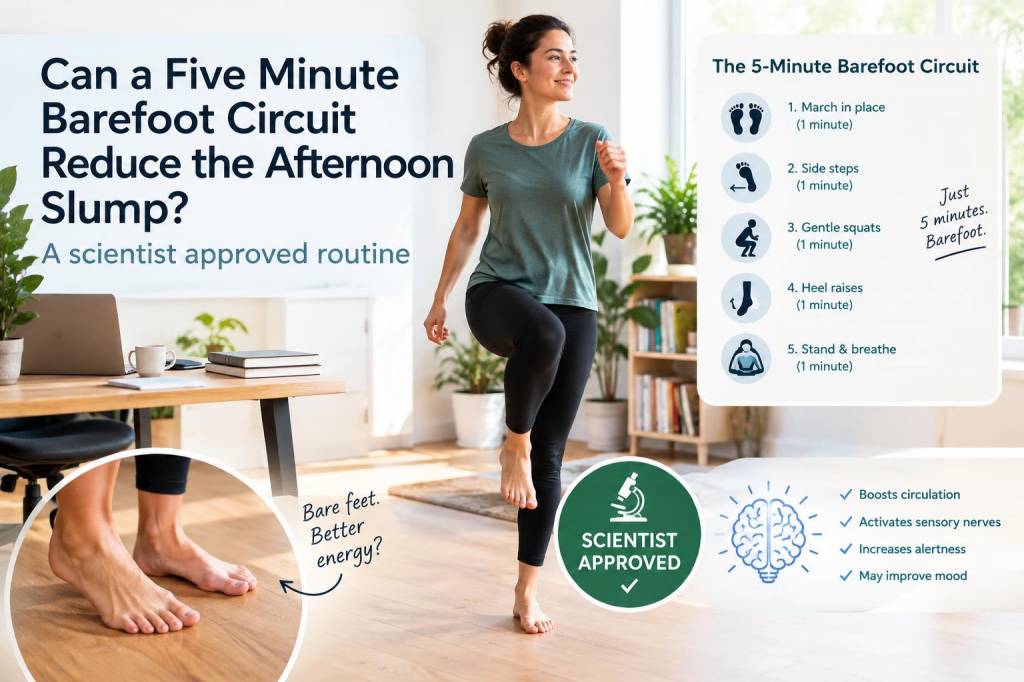
I used to rely on coffee and a killer to‑do list to get me through the post‑lunch slump. Then I started experimenting with something much simpler: a five‑minute barefoot circuit that wakes up the body and clears the fog without caffeine. It’s short, portable, and—surprisingly—scientist‑friendly. I’ve tested it on gray office carpets, sun‑warmed park grass, and my kitchen tiles, and I’m sharing what works, why it works, and how to try it safely.
Why a five‑minute break actually helps
The afternoon low—often between 1pm and 3pm—is a real thing. It’s a mix of circadian rhythm dips and the body processing whatever you ate for lunch. Instead of thinking of it as laziness, I try to treat it as a predictable signal: my brain needs a short reset.
Short bursts of movement are well supported by research for improving alertness and cognitive performance. Studies have shown that light to moderate activity for as little as three to ten minutes can reduce subjective sleepiness and boost attention and reaction time. Movement increases blood flow to the brain, increases heart rate just enough to be waking, and triggers neuromodulators (like norepinephrine) that sharpen focus.
Doing the circuit barefoot adds an element of sensory stimulation. The soles of our feet have lots of nerve endings and proprioceptors that send rich information back to the brain. Standing or moving barefoot on different textures—grass, carpet, tile—creates a subtle, immediate sensory feedback loop that helps recalibrate posture and alertness. There is ongoing research into “grounding” or “earthing” (direct contact with the Earth), with mixed results, but the sensory and proprioceptive benefits of barefoot movement are straightforward and physiologically plausible.
My five‑minute barefoot circuit (science‑friendly and simple)
I designed this circuit to combine gentle cardiovascular activation, balance work, and foot/ankle mobility. Do it in order, each move for the listed time. No equipment required—just a small clear space and the option to go outdoors if you like.
| Move | Duration | What it does |
|---|---|---|
| Warm‑up march (on the spot) | 45 seconds | Raises heart rate and circulation |
| Heel raises | 30 seconds | Activates calves, improves ankle stability |
| Toe spreads and scrunches | 30 seconds | Strengthens intrinsic foot muscles, sharper sensory input |
| Single‑leg balance with gentle knee bend (switch sides) | 30 sec per side | Improves proprioception and focus |
| Walking lunges (slow, mindful) | 60 seconds | Opens hips, engages large muscles, increases blood flow |
| Toe‑walking forward, then heel‑walking back | 45 seconds | Targets different parts of lower leg, challenges balance |
| Ankle circles + gentle knee bends | 30 seconds | Mobilizes joints, reduces stiffness |
| Box breathing (inhale 4 / hold 4 / exhale 4) | 45 seconds | Calms scattered thoughts, brings attention inward |
How to do each move (quick cues)
I like short cues that prevent me from overthinking the sequence. Here’s how I do each part without turning it into a workout challenge—this is a reset, not HIIT.
Where and when to do it
Indoors on carpet, hardwood, or a yoga mat works fine. Outdoors on grass is my favourite: the cool, textured surface feels instantly refreshing. If you work in an office, I’ve done this in a quiet corridor or empty meeting room. Five minutes. No costume change. No gym bag.
Timing: I aim for 60–90 minutes after lunch—when the slump typically hits. If I feel a 3pm droop, I’ll do the circuit and then sit down to a short, focused 25‑minute work block (Pomodoro style). It’s a nice reset and I find I get more done in that next stretch than I would have after an extra coffee.
Safety, modifications, and practical tips
Being barefoot isn’t for everyone. If you have foot problems (plantar fasciitis, recent foot/ankle injury, or neuropathy), check with a clinician before trying unshod movement. You can do the same routine in thin socks or supportive shoes—focus on the movement and the sensory attention rather than the barefoot ideal.
What I noticed after a week of doing it
After trying this daily for a week, my afternoon mood felt brighter and my afternoon caffeine intake dropped. The immediate effect is physical—my shoulders loosen, my chest opens, and the brain feels clearer. The cumulative effect is mental: by acknowledging the slump with a short ritual rather than pushing through with stimulants, I feel less reactive and more intentional about my energy management.
It’s small, but small things compound. If you try it once, notice how you feel; if you try it three times, compare notes. And if you’re curious about the underlying science, look for brief studies on short‑bout exercise and cognitive function or research on proprioception and balance—there’s a neat body of work that supports the practicality of this tiny habit.
Give the five‑minute barefoot circuit a go and tell me how it lands. Whether you do it on sun‑warmed grass or a kitchen floor, it’s a friendly little experiment in paying attention to what your body needs halfway through the day.